Urban aesthetics. On the modernity of Ventura Terra, architect and town planner
Contents
Book chapter published in Southern modernisms: From A to Z and back again, edited by Joana Cunha Leal, Maria Helena Maia and Begoña Farré (Porto: CEAA, IHA, 2015. pp. 99-124). The entire book is available at http://southernmodernisms.weebly.com/uploads/3/0/0/9/30098279/leal_j.c._%282015%29_southern_modernisms_-_from_a_to_z.pdf. The chapter is an extended version of a paper presented at the Conference “Southern Modernisms: critical stances through regional appropriations,” held in Porto, February 19-21, 2015.
The architect Ventura Terra became first involved in town planning as town councillor of Lisbon (1908-1913). In this article I want to discuss the relevance of aesthetic considerations in his planning activity, arguing that they were both constitutive and marks of his modernity. “Urban aesthetics” and public space, concerns circulating both locally and internationally, are used to approach one of his projects, the Eduardo VII park, in order to uncover the importance of aesthetic motivations in the production of urban space in early 20th century Lisbon.
Miguel Ventura Terra and Republican Lisbon
The Portuguese architect Miguel Ventura Terra (1866-1919)1 was member of a Lisbon town council elected in November 1908 and in this function became heavily involved in town planning.2 This town council was the first entirely Republican council to manage the city’s affairs. Elected almost two years ahead of the Republican revolution of 5 October 1910, and less than a year after the king’s murder (1 February), it worked in a predictably hostile political context.3
Though in a certain way instrumental in the Republican victory in 1910 and notwithstanding much initial enthusiasm, the council grows increasingly disillusioned with the politics and priorities of the new Republican State. After voluntary resigning it is substituted on 1 February 1913 by an Administrative Commission. Officially the council claimed fatigue and ever-postponed municipal elections, but it was also involved in a series of wearing conflicts.
A painting by Veloso Reis Salgado (A cidade de Lisboa elege a primeira vereação republicana [The city of Lisbon elects its first Republican town council], 1913 , Fig. 1) seems to picture the difficult relationship between the new State and town council. It was commissioned in 1912 for a newly decorated meeting room destroyed in a 1911 fire. The subject was the victory at the 1908 municipal elections but only two of the councillors make a modest appearance: its president Braamcamp Freire and Ventura Terra. The other figures are all important national politicians, whose imaginary in a sense hijacked the scene.4
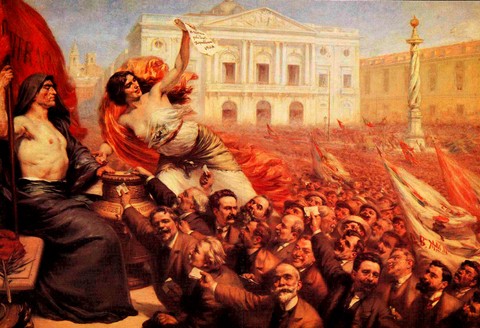
Why is Ventura Terra there, but none of his fellow councillors but the president? Perhaps it indicates his public visibility during his years as town councillor. Maybe the friendship between both artists played a role. But possibly it was also a way of the painter acknowledging the architect’s services to the cause of the arts. For this short detour through painting introduces a somewhat obscure entity: the Commission of Municipal Aesthetics. This Commission, created by Ventura Terra, was responsible for the painting’s commissioning process and also the main user of the room in which it was hung (Fig. 2).5

As will be seen, this commission played (or was supposed to play) a relevant role in planning projects and the production of urban space. It is this relation of planning to arts, and this strange concept of municipal aesthetics, which will structure my discussion of Ventura Terra’s municipal activity. With this I hope to offer a new perspective on his work in Lisbon,6 as yet little studied.
Specially, I want to counter the idea that his proposals were strictly utopian. None of his projects were in the end executed and his overall program is difficult to reconstruct. This has facilitated its qualification as one more project in a line of failed urban modernization.7 Though there are many arguments for such a reading this characterization produces an apparently easy legibility of Ventura Terra’s projects which fails to recognize the way they articulate with and work within a highly complex context.
Culturalists and progressives in Portuguese art history
In the background is an idea suggested by the art historian Raquel Henriques da Silva in what is until date the most informed study on Ventura Terra’s planning activity.8 One of Silva’s arguments is that Ventura Terra’s town planning is founded on an idea of the city which simultaneously respects history and is open to expansion and modernization. For this reason she suggests it can be interpreted as a synthesis of Françoise Choay’s opposition between “progressive” and “culturalist” attitudes towards planning and urban heritage.9
This reading of Ventura Terra’s work against an international context is especially relevant in light of a persistent historiographical bias on the insularity of this time and place.10 But if Silva’s reading is very useful to revisit Ventura Terra’s planning activity and place it within an international (architectural and planning) culture, this particular hypothesis of a synthesis of Choay’s opposition poses some problems.
Before exploring these it may be useful to shortly outline the genealogy of the use of this opposition in Portuguese art history. One of Silva’s fundamental references is Pedro Vieira de Almeida’s work, particularly his understanding of the transition from the 19th to the 20th century in Portugal not as rupture but as a continuity increasingly questioning its tradition.11 It was precisely Almeida who first introduced Choay’s terminology in Portuguese architectural history.12 Almeida did so not in the context of planning but rather in that of architecture, proposing a fresh reading of the first decades of the 20th century as a time marked by modernity rather than its absence.
Ventura Terra was the architect he elected to represent what he called the progressive model in Portuguese architecture (Raúl Lino exemplified the cultural model). This original appropriation or detour brought to light the complex temporalities of architectural production at that time, providing Almeida with the conceptual instruments to revisit both architects beyond the problem of style their work until then often had been confined to.13
If Almeida considers Ventura Terra to be quintessentially progressive, the fact that Silva proposes to consider the architect-planner as having surpassed Choay’s opposition signalizes a certain discomfort in turning the latter’s model back to its original context of town planning and heritage. And hence we come back to the two problems I consider this hypothesis poses.
Firstly, an important argument of Silva is Ventura Terra’s understanding of heritage as something to be preserved but which should not thwart urban development.14
Choay herself notes her models are only to be found in its pure form in discourse, as they consider the city as a reproducible object and not as a process or a problem.15 Both models refuse the actually existing city by calling either on the past or the future, that is, by invoking a normativity based on either tradition or modernity which is their necessary utopian element. Any concrete planning activity is necessarily some kind of compromise or synthesis between both models, which are present in varying proportions. They should rather be understood as ideal discursive types, extremes forming a line along which to place actors and ideas.
In this sense one could as well consider Ventura Terra an ‘enlightened progressive’, for example, for the difference between both models or attitudes reveals itself best when urban heritage does obstruct urban development. And Ventura Terra repeatedly states his availability for opening large avenues trough historical districts for the sake of “progress”. An example would be an avenue preceding a future bridge over the Tagus river between Príncipe Real and Alto da Catarina, which would raze part of the centenary neighbourhood of Bairro Alto.16
Secondly, Choay’s problematic of how past and present are articulated in planning views may not be the most pertinent approach to the case of Ventura Terra (as will be noted later, Silva herself suggests other readings). Silva bases her idea of a synthesis on Ventura Terra’s pragmatic attitude towards modernization and urban heritage, which contrasts with the much more radical discourse of his time.17 Such pragmatism reveals itself in Ventura Terra’s somewhat straightforward attitude towards both the city inherited from the past and the new possibilities, necessities and challenges arising from new technologies.
For the architect they seem to have been elements to work with rather than conflicting or mutually exclusive demands, i.e. means rather than ends. The coexistence of ‘progress’ with persistences and survivals of the past didn’t pose what Ramos calls in another context the “anguish of choice."18 Perhaps, in line with ideas about the constitutional “porosity” or “impurity” of modernity in Lisbon19 it can be argued that for Ventura Terra the past was inevitably present but not necessarily an obstacle; that past and present coexisted rather than conflicted. This suggests bypassing rather than surpassing Choay’s opposition. The basic problems Ventura Terra faced, or thought he faced, may not have been those which Choay’s model helps to make visible.
Finally, the idea of a synthesis still implies a reading of history focused on evolution (in the sense of a Hegelian synthesis of an opposition as historical progress). The European context which according to Almeida and Silva informed Portuguese architectural culture rather seems to demand exploring the spaces and circulations through which ideas, models and theories on planning were confronted with the specificities of place.20
Hence we come back to that strange concept of “municipal aesthetics” or, more generally, “urban aesthetics” (see below). This term, at least in the sense developed below, seems to escape Choay’s models. In what follows, I want to argue that nonetheless it had a constitutive character in Ventura Terra’s planning projects and is one way to discuss its “modernity” and the particular way it articulates the “weight of place”21 and international context.
Urban aesthetics
“Municipal aesthetics” is among a series of terms one finds frequently during the first decade of the 20th century in discourse on the city of Lisbon. Expressions as “aesthetics of the city” (estética citadina, estética da cidade), “urban aesthetics” (estética urbana), “aesthetics of the street” (estética da rua) or of buildings (estética das edificações), etc., appear consistently in texts by historians, writers, architects and other intellectuals. I will use the generic term “urban aesthetics” to cover this constellation.22
The discussion these terms were used in was part of a public debate on the aesthetic quality of the city. While having roots in the last decades of the 19th century it gained momentum during the first decade of the 20th century. This discussion focused on but was not limited to architecture, particularly façades. It was a topic which concerned many intellectuals and pervades writing, as inventories of the debate show.23
Rute Figueiredo notes how the evident desire of “aesthetization” which this vocabulary articulates is a defining feature of debate on architecture and the city during the early 20th, related to ideas then circulating internationally.24 At its basis was a critique of the aesthetic insufficiency of the modern city. In this sense, Alessandro Piccinelli’s description of the situation in Milan before the first World War is quite similar to that in Lisbon: journalist, writers and other intellectuals used the concept of estetica urbana to react in a common front against what they considered purely hygienist approaches ruining the city.25
If this international context and its protagonists are hardly ever mentioned explicitly in Portugal, the discussion around an “urban aesthetic” is best seen against this background. This can be illustrated with an early text on occasion of the 1900 Congrès de l’Art Public held in Paris as part of the International Exhibition.26 (Curiously when in 1910 Ventura Terra is compared to an unidentified but daring “painter of the Oeuvre” this seems to refer to Eugène Broerman, promoter of the Belgian Oeuvre de l’Art Public which organized these congresses.27) The pseudonymous author advocates an “aesthetic of the street” as solution for the failure of aesthetic control of public space. Implicit is the claim that the aesthetic quality of public space is a matter of public concern, and that for this reason there was a public right of regulation and intervention.
While in Milan, as elsewhere, this reaction developed into an (international) dialogue and systematic theoretical reflection28 in Portugal it hardly goes beyond a basic consensus on the lack of aesthetic quality of the city. Only during the 1930s one finds a more serious attempt at defining the idea of an “urban aesthetic."29
Though it is quite possible to inventory imaginations and literary fictions of a different city during the 1900s according to Choay’s models, these didn’t translate into competing urban programs. They mostly coexisted without major problems, converging in an apparent consensus of what in fact were different interests.30:
For these reasons in Portugal I think it makes more sense to talk of “urban aesthetic” not as a real concept but rather as a common place in which distinct actors and interest could converge and make a common front against then current planning practices.
One of these interests was that of architects, recently organized in their own class association (SAP, Society of Portuguese Architects, founded in 1902). They attempted to appropriate the issue as their special domain in order to fortify there weak social and professional status, arguing that architects were the professionals best qualified to deal with the city’s “aesthetic."31 The exercise of aesthetic control over the urban environment seemed one way to obtain a larger public relevancy.
This becomes clear in a statement delivered to the Town Council of Lisbon in 1907.32 Under the title “The aesthetic of the capital” the architects called for a regulation of the “aesthetic of building” to counter the “criminal freedom” of owners and constructors, held to “suffocate” the city with banal constructions “devoid of the most elementary conditions of beauty."33 The issue was presented as one of civilization, progress and artistic education:
In all countries, and not only in their capitals but also their most grandiose cities, the embellishing of façades has been law for a long time. In some cities owners have to build in accordance with a type of architecture which gives unity to the square or avenue; in others awards are established for the façades with most beautiful artistic conception. Among us, however, we have not taken care yet of such an important issue, sadly neglecting the triumphal march of civilization.34
It must be noted that this account was a little exaggerated, regarding both the esteem the subject was said to receive in other countries as the local neglect: an award for façades existed since 1902 in Lisbon, fulfilling precisely the desired “civilizing” function.35
But what is most interesting is the way the aesthetic dimension of the street is understood as a public good. The street is defined as public space (logradouro dos municipes), and as architectural façades form the vertical limits of this space the architects argue for the exercise of “artistic censorship."36 This justifies the demand for a more prominent place for architects within the modern city, by way of municipal aesthetic regulation, supervision and appreciation exercised by a specialized entity composed of artists.
The institutionalization of aesthetic control
The fundamental question is thus aesthetic control of the built environment. The underlying question was that of city-building as an art, depending on intuition or feeling in response to place, and not just a science, susceptible of codification. It was the way for architects to promote and differentiate themselves from other urban professionals – especially engineers – by their possession of “artistic feeling,” and to present themselves as capable of saving the city from aesthetic failure.
Ventura Terra was an active member of the SAP, being vice-president of its general meeting board. He was thus well aware of these aspirations and it can be presumed he took this program in favour of aesthetic control of public space with him when he is elected town councillor in 1908.
The issue of aesthetics is precisely one of the main points in the general outline of proposals Ventura Terra presented during one of the first municipal sessions.37 It figures prominently among the study of a general “improvement plan” (plano de melhoramentos) of the city focusing on the river and strategic urban projects such as the execution of the Eduardo VII park, the solution of a traffic bottle-neck (Rua do Arsenal) or the creation of a green belt around the city.38
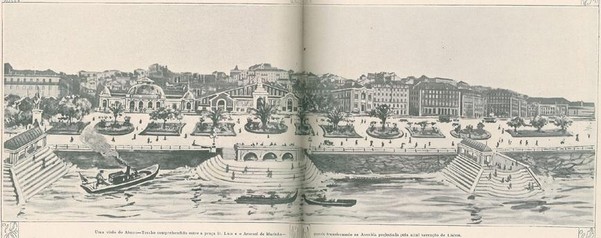
The ideas on the waterfront have called most attention, being the most articulated plans for waterfront development during a period which seems to turn its back to the river,39 and anticipating recent waterfront developments in Lisbon much along the same lines.40 Ventura Terra in fact enthusiastically defended such a “return to the Tagus” 41 (Figs. 3 and 4).

The first of his proposals was precisely to study the means of more municipal control on the “aesthetic” of buildings:
To carry out a study in order to authorize town councils to intervene in the aesthetic of future buildings in their respective municipalities, above all when concerning more important streets, avenues or squares.42
The existing legal framework impeded the creation of such legislation43 but during the second half of 1909 a Commission of Municipal Aesthetic (Comissão de Estética Municipal) is created on Ventura Terra’s proposal. The Commission was composed of the municipal President, the directors of the Department of Public Works and of its subsection of Architecture; from outside the municipality, an architect, painter, sculptor and art critic elected by the Royal Association of the Fine-Arts, and members of the Council of National Monuments, the National Society of Fine-Arts and the architect’s Society. As the architects had asked, it was tasked with exercising municipal control over the city’s aesthetic and its “artistic comfort,” in which there is a significant concern with taking advantage of the “magnificent panoramas” of the city, besides the aesthetic appearance of public spaces (avenues, squares, parks, etc.).44
Its real functioning is difficult to reconstruct, as the minutes of their meetings have not been located in the Municipal Archive. But the Commission regularly appears in the municipal minutes as being consulted about or giving opinions on matters relating to aesthetic issues.45
#Aesthetic conflict and the Eduardo VII park This general intention of exercising aesthetic control over the built environment rapidly gets caught in the politics of municipal management. I want to follow this entanglement by discussing Ventura Terra’s plan for the central park to crown the most important avenue of the city, the Avenida da Liberdade.
This park project was in fact a variant of an 1899 project already in (slow) execution, which was itself a re-elaboration by the municipal Department of Public Works of an original 1895 project by the French entrepreneur Henri Lusseau. The revision of this project was for the town council a priority, as its ever-postponed execution was the very image of the city’s frustrated desires of modernization. The 1910 revolution invested the site with additional symbolism (the Marquês de Pombal square and the lower part of the park were strategic to the revolution’s success).
His project was one of the first causes of conflict with the engineer since 1909 in charge of the municipal Department of Public Works, Diogo Peres. Aesthetic arguments were central in this conflict. From the start Diogo Peres is highly critical of Ventura Terra’s variant project.46 He files two reports on the project in which he develops his critiques.47 In 1912 he states them publicly in the newspaper A Capital, for which he is questioned by the town council and officially reprimanded.48
The conflictual views on the park, which will be discussed later, were certainly an important reason for Ventura Terra to remove the project’s elaboration as much as possible from Peres’ control. In June 1911 he has it transited from the garden section of the municipal Department of Public Works to the architectural section, directed by the architect José Alexandre Soares. His argument was the project was “a work in which art dominates,” specially the “arts of landscape architecture, monumental architecture and urban architecture."49
In July he further proposes to reorganize the entire Department of Public Works, dividing it into two new Departments, one of Architecture and another of Engineering. He gives as a reason the need to distinguish between the competences and responsibilities of engineering and architecture, against the national “routine” of the latter’s submission to the first.50
His reorganization thus had an exemplary intention, backed by international good practices. It is enthusiastically received by artistic and architectural circles (SAP, Council of Art and Archaeology and National Society of the Fine-Arts).51 Ventura Terra himself presents his reorganization at the IX International Congress of Architects in Rome (2-10 October 1911) and relates it to the congress’ conclusions on the separation between architecture and engineering.52
The following brief overview53 of the redistribution of competences clearly shows Ventura Terra wanted to remove aesthetic issues entirely from Peres’ influence.
Until 1911: Organization of the Department of Public Works (3.ª Repartição)
- First section
- Building lines
- Studies
- Public space occupancy
- Second section of architecture
- Third section
- Gardens
- Water services
- Lighting and rails
- Fourth section of roads and pavements
- Fifth section
- Purchases
- Expropriation
- General administration
After 1911:
- Department of Engineering (3.ª Repartição)
- Engineering
- Surveys
- Public utilities (sewage, water, gas, electricity)
- Pavements and roads
- Department of Architecture (4.ª Repartição)
- Architecture
- Parks and gardens
- Cemeteries
- General composition of the city plan
- Urban furniture (including ornamental pavement)
- Public art
- Public space occupancy
- Shared administrative services
The creation of the Commission on Municipal Aesthetics and the reorganization of the municipal Department of Public Work will be Ventura Terra’s most lasting municipal interventions. Architecture will maintain from here on its autonomy within municipal services, though over time it lost many of its ample attributions (gardening, cemeteries, planning, public space…).54
Against this background it doesn’t surprise to see Diogo Peres appear in 1914, after the town council leaves office in January 1913, as one of the promoters of the Eduardo VII project’s suspension and substitution for the earlier project from 1899 he championed.55
Aesthetics and public space
Against this background the Eduardo VII project can be considered as a test-case for Ventura Terra’s complete improvement plans, as he also announces when work starts.56 It presumably had to show the advantages of an “aesthetic,” architectural approach, as both more efficient and with better results than the “old” engineer-based approach.
Ventura Terra proposed to solve the problem of financing the park’s construction - the main reason of its slow execution - by selling a strip of land on its edges as building lots for “artistic” residences. He imagined them somewhat like a high-class garden-city surrounding the park.57 Two auctions of these lots were realized but failed: only one lot was sold. The buyer was the Paris-based artist Artur Prat (1861-1918), who had Ventura Terra himself design the house. Prat created the sculpture and painting integrated in the façade of the house facing the future park (Fig. 5).58 This concern with the integration of the arts, represented in the sculpture itself (Fig. 6), reinforces the suspicion that this house was to function as a showcase for the architectural possibilities of these lots. This was also the way it was understood in the specialized press.59
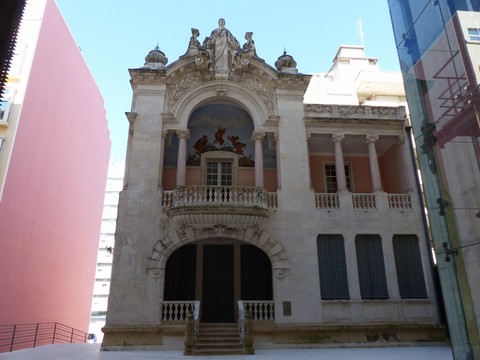

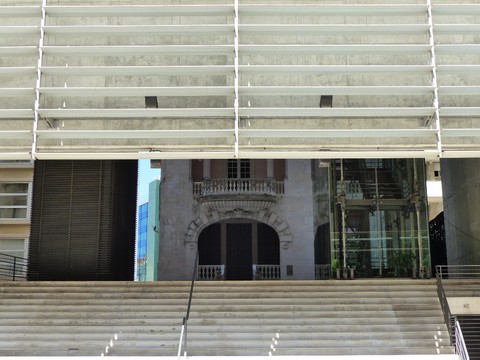
The project’s suspension left the house surrounded by a building site for the following decades. Today, cased into modern iron, concrete and glass, it ironically houses the Order of Engineers, as if it were an involuntary monument to the architect’s defeat in this particular instance of the conflict between engineers and architects (Fig. 7).
Another mayor change in Ventura Terra’s proposal was the location of the Exhibition Palace, perhaps the real breaking point in his conflict with Diogo Peres. The park is located at a spot where a hill with a steep slope blocked the continuity of the Avenida da Liberdade linking it to the city’s centre. The palace was originally to be located at the top of that hill. Ventura Terra moves it to a large Promenade in front which substitutes an original lake (Fig. 8).
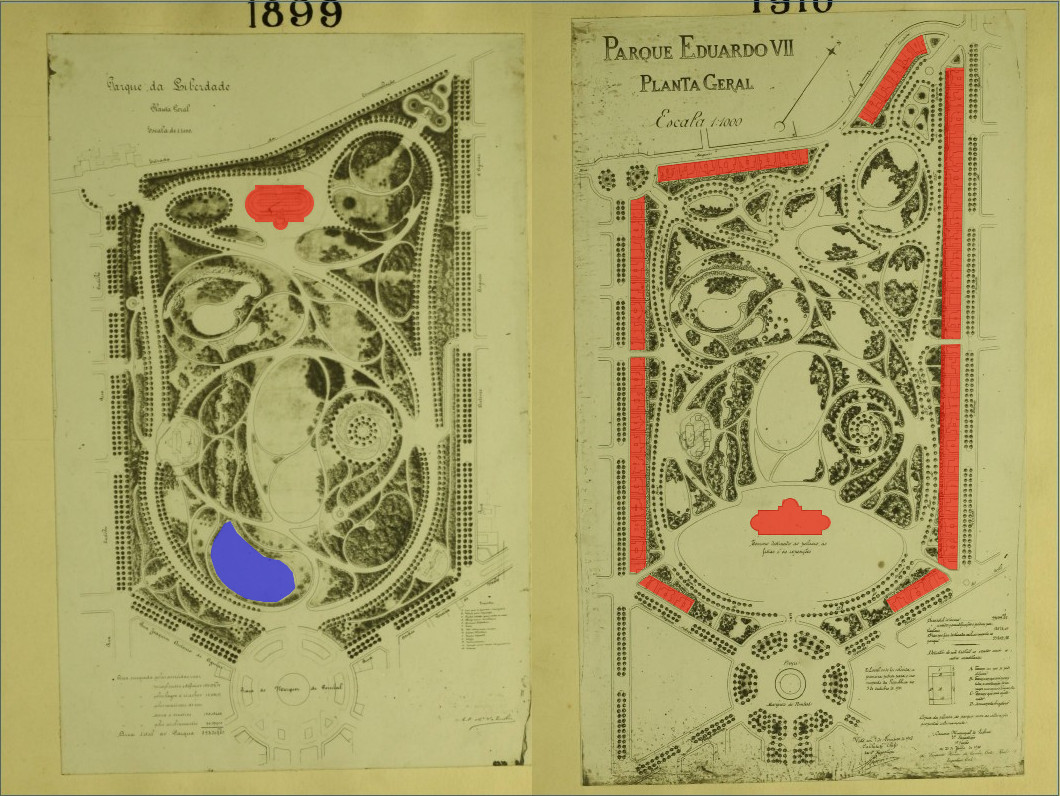
Peres considered surrounding a park by buildings in principle a bad idea and defends the stylistic unity and “harmonious whole”60 of the 1899 project. In his arguments one detects the importance of the visual: scenographic perspectives of the palace were to visually dominate the city, with the park as picturesque frame. Hence he can’t accept Ventura Terra’s idea of the promenade, on which the palace would be placed with the park “jammed” behind it. For Peres the palace should be situated either next to the square, thus ennobled by a “grandiose” and “imposing” monumental façade; or, preferably, on the original spot on top of the hill, “one of the most beautiful viewpoints of the city."61
But this way palace and park were separated from the city itself. Looking at artistic renderings of the 1899 project (Figs. 9 and 10) it is easy to see how they imagine the park as an enclosed area of nature, as a refuge of small waterfalls, soothing water and meandering paths in which to forget the horrors of urban civilization.
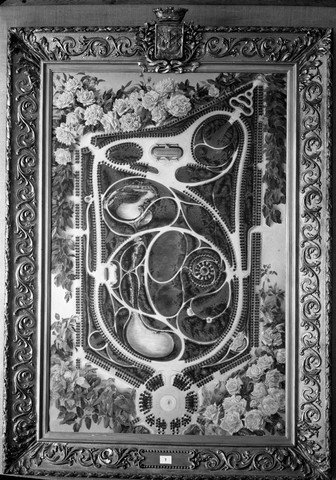
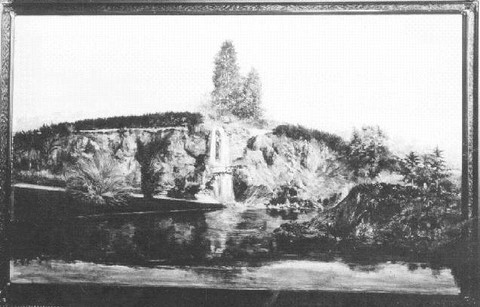
What is absent in Peres’ considerations is the public use of both palace and park. It is another architect, Adães Bermudes, who answers Peres’ objections.62 His main arguments can thus be summarized:
- the palace is to be visited, and the top of the park would hamper access;
- its function it is to exhibit what is inside and not to watch the views, for which a proper construction (such as a watchtower) would be much fitter;
- the trees of the park would impede the very view from the park’s top, or else it would have to be park without trees.
Similarly Bermudes counters the idea of placing the palace immediately next to the Marquês do Pombal square, as Peres had considered in alternative, for the logistic problem of access and circulation this would create. He thus argues Ventura Terra’s idea is the only valid one by prioritizing arguments of functionality over those of imposing scenery, picturesque views, or stylistic integrity.
The background to these disagreements seems then to have been Peres’ conception of the park as an enclosed artwork against Ventura Terra’s priority of use and functionality in the organization of artistic elements. One could say that for the latter public space should not be sacrificed to an imagined aesthetic harmony or unity. His proposal, by putting the palace near the Marquês de Pombal square – predictably a future point of convergence – while creating an inviting promenade at the very start of the park, would open it up to urban life and thus constitute it as public space.
The building of the palace at about 150 meter of the Marquês de Pombal square is justified by the need to make it easily accessible to the public and because of its more attractive situation. In front of and along the palace a large gardened promenade will be built with lakes, waterfalls, statues, balustrades, etc., after which the park unfolds with a perfect view over the city, the Tagus, etc.63
The palace would function as an entrance rather than a wall. The same reasoning can be noted in his defence of the residential belt around the park. A series of isolated and artistically distributed houses surrounded by greenery would be much more attractive than the original fencing he elsewhere defined as chicken wire.64 They would also help to mediate the considerable height differences along the park’s limits, up to 8 meters, which the 1899 project solved by slopes. While the slopes and fences would set the park apart from the city, isolate it, architecture could mediate the heights and integrate the park into urban space.
The conflict between the engineer and architect thus shows different perspectives on what the park’s design should aim at: in Peres’ case, the park and palace should be designed in order to aesthetically frame the city, to create impacting visual images, while for Ventura Terra the starting point is that the park should be a stage for social interaction and cultural events. Architecture was to mediate public space, an idea similarly present in other projects of his (Figs. 3 and 4). This shows that while architecture seems to dominate his projects, the real object of intervention is public space.
Conclusions
The park as imagined by Ventura Terra implies the appropriations of both local, place-specific elements and international ideas and ideals. The aesthetic considerations of architects and other intellectuals were very much related to modernization: for them, the revitalization of public space was to be a motor for urban regeneration, and though this revitalization was primarily aesthetic, this was not understood in a purely formal or aestheticist sense, as Bermudes’s words make clear:
This splendid centre of art and beauty [the Eduardo VII park] will be the first marker of modern civilization. It will ennoble the city and place it side by side with other great capitals. It will be our tuning-fork to harmonize the aesthetic transformation of our cities with. It will educate public taste and irradiate victorious and comforting art.65
“Aesthetics” in a certain way mediated oppositions between the values, desires and temporalities which puncture Lisbon and its architecture at the turn of the century. In this sense “urban aesthetics” can be understood in the light of a “response to place,” in the sense the Italian Monneret de Villard had proposed:
[…] the art of city-building is not a table art, made of rules, maxims and formulas, but instead arises from the close connection of an artistic vision in correspondence to the place it concerns.66
To end I want to come back to another reading of Ventura Terra suggested by Silva. She considers him a representative of the entrance of architecture in the “terrain of non-art”, which she considers the birth-place of modern architecture.67 I think this “terrain” can be understood as the city itself. In the case of Lisbon, it was through a putative “urban aesthetics” that architecture attempted, without losing its identity and relevance, to leave the strict confines of “Art” to enter this reality in which the frontiers separating (monumental) architecture from “non-architecture” were rapidly dissolving. The horizon of this entrance was to take art to the streets, that is, to diffuse artistic rationalities throughout the entire city. Ventura Terra’s activity – however short and without apparent results – thus comes close to what Pedro Brandão somewhere called “the cultivation of the urban."68
This paper is based on PhD research funded by the FCT – Fundação para a Ciência e Tecnologia. All translations are mine.
-
On the architect and his work, see Tereza Xardoné, Rui Costa, and Maria de Lurdes Rufino, eds., Arquitecto Ventura Terra, 1866-1919, Lisbon 2009. ↩︎
-
I will use the designation “town planning” throughout this article, as it was the most current British expression at the time. I’ll use it in Unwin’s general sense as the “art of designing cities” (Raymond Unwin, Town planning in practice: An introduction to the art of designing cities and suburbs, London 1909), covering the whole spectre of city-building varieties being cultivated around Europe and the USA during the early 20th century. For an overview, see among others Wolfgang Sonne, “‘The entire city shall be planned as a work of art.’ Städtebau als Kunst im frühen modernen Urbanismus 1890-1920,” in: Zeitschrift Für Kunstgeschichte 66 (2003), 207-36, and Charles C. Bohl and Jean-François Lejeune, eds., Sitte, Hegemann and the metropolis: Modern civic art and international exchanges, London and New York 2009. ↩︎
-
See Lisboa e a República: Centenário da vereação republicana em Lisboa, 1908-2008. Actas do Colóquio Nacional Lisboa e a República, Lisboa, 2008, Lisbon 2010, and António Reis, ed., Lisboa republicana: Espaço e memória, 1910-1926, Lisbon 2010. ↩︎
-
On the painting and its history, as well as the identification of its characters, see A cidade de Lisboa elege a sua 1.ª vereação republicana. Comemoração do 1.º Centenário 1908-2008, 2nd ed., Lisbon 2008 (published on the site of the Museu da Cidade, http://www.museudelisboa.pt/; at the moment of writing this publication was not accessible). ↩︎
-
For the involvement of this commission in the room’s restoration, see Actas da Câmara Municipal de Lisboa, Lisbon 1912, 53. ↩︎
-
After his planning activity in Lisbon Ventura Terra also produced an ‘improvement plan’ for Funchal, capital of the Madeira archipelago. See Teresa Vasconcelos, O Plano Ventura Terra e a modernizaçao do Funchal (primeira metade do século XX), Funchal 2008. ↩︎
-
This idea is present in different senses in A. Vieira da Silva, “A ligação costeira da Baixa com a parte ocidental da cidade,” in: Dispersos. Volume I, 2nd ed., Lisbon 1968, 113- 134; José Manuel Fernandes, Arquitectura modernista em Portugal (1890-1940), Lisbon 1993, 74; Ana Martins Barata, Lisboa, ‘caes da Europa’: Realidades, desejos e ficções para a cidade (1860-1930), Lisbon 2010. ↩︎
-
Raquel Henriques da Silva, “Ventura Terra em contexto,” in: Miguel Ventura Terra. A arquitectura enquanto Projecto de vida, ed. Ana Isabel Ribeiro, Esposende 2006, 10-30. The text is reproduced in Xardoné, Costa, and Rufino, Arquitecto Ventura Terra, 276- 307. ↩︎
-
Françoise Choay, ed., L’urbanisme: Utopies et réalités. Une anthologie, Paris 1965. ↩︎
-
Silva’s suggestion was not followed when a Colloquium on the first Republican town council, organized by the Municipality of Lisbon, provided the opportunity for further study. Here Ventura Terra’s work was described as “intensely utopian”, ahead (and consequently outside) of his time. Jorge Mangorrinha, “À esquina de Lisboa: O perfil dos vereadores da mudança e a política urbanística (1908-1913),” in: Lisboa e a República, 125-155. Though no interpretative model is explicitly mentioned, Mangorrinha’s reading implies the dichotomy between visionary exceptions and a provincial, backward and limiting cultural context which does not allow these exceptions to fructify. For a critique of such models in Portuguese art history, see Mariana Pinto Santos, “‘Estou atrasado! Estou atrasado!’ Sobre o atraso na arte portuguesa ddiagnosticado pela historiografia,” in: Representações da Portugalidade, eds. André Barata, António Santos Pereira, and José Ricardo Carvalheiro, Alfragide 2011, 231-242. ↩︎
-
Silva, “Ventura Terra em contexto,” 17; Pedro Vieira de Almeida, “A noção de ‘passado’ na arquitectura das décadas difíceis. O caso de Lisboa,” in: Rassegna 16 (1994), 52-63. ↩︎
-
Pedro Vieira de Almeida, “Modelo progressista, modelo culturalista,” in: História da arte em Portugal: A arquitectura moderna, ed. Pedro Vieira de Almeida and José Manuel Fernandes, Lisbon 1986, 72-89. ↩︎
-
See Rui Jorge Garcia Ramos, “Disponibilidade moderna na arquitectura doméstica de Raul Lino e Ventura Terra na abertura do século XX,” in: Revistas de arquitectura: Arquivo(s) da modernidade, ed. Marieta Dá Mesquita, Lisbon 2011, 78-111. ↩︎
-
Silva, “Ventura Terra em contexto,” 17. ↩︎
-
Choay, L’urbanisme, 26. ↩︎
-
See “A futura ponte sobre o Tejo,” in: A República, 16 April 1911; “Lisboa transforma-se… Vão começar as obras do Parque Eduardo VII,” in: A Capital, 2 June 1911; “Lisboa transforma-se. Quem vae construir a ponte sobre o Tejo?” in: A Capital, 6 June 1911. ↩︎
-
Discourse on the city at this time follows Choay’s model much closer. It argued with few exceptions either for completely razing the historical districts or not to touch them at all. See Joana Cunha Leal, “A individualidade de Lisboa e o tipo de casa portuguesa em Júlio de Castilho,” in: Vinte e Um por Vinte e Um 2 (2006), 73-85. ↩︎
-
Rui Jorge Garcia Ramos, “Raízes e caminhos: Marques da Silva e a arquitectura do século XX,” in: Leituras de Marques da Silva: Reexaminar a modernidade no início do século XXI, ed. Rui Jorge Garcia Ramos, Porto 2011, 15-27, here 26. ↩︎
-
As proposed respectively by Manuel Villaverde, “Rua das Portas de Santo Antão e a singular modernidade lisboeta (1890-1925): Arquitectura e práticas urbanas,” in: Revista de História da Arte 2 (2006), 142-76; and Ramos, “Raízes e caminhos,” 25. ↩︎
-
Silva, “Ventura Terra em contexto,” 15. For the idea that the study of “peripheries” should focus on “space and circulations before constructing evolutions”, see Béatrice Joyeux-Prunel, “The uses and abuses of peripheries in art history,” in: Artl@s Bulletin 3 (2014), 4-7, here 7. ↩︎
-
Ramos, “Raízes e caminhos.” ↩︎
-
I follow Brian Ladd in his use of the term in his discussion of the challenges to planning approaches based on aesthetic grounds, within a wider context of the (tentative) systematic development of the aesthetic dimension of planning. According to Ladd, this came with a new understanding (a “discovery”) of the urban fabric. Brian Ladd, “Urban aesthetics and the discovery of the urban fabric in turn‐of‐the‐century Germany,” in: Planning Perspectives 2 (1987), 270-86. Much interesting research in this direction has been developed in the wake of the ‘rediscovery’ of Camillo Sitte since Collins’ 1986 translation of Sitte’s seminal 1889 Der Städte-Bau nach seinen künstlerischen Grundsätzen. See among others George R. Collins and Christiane Crasemann Collins, Camillo Sitte: The birth of modern city planning, Dover edition, New York 2006. Bohl and Lejeune, Sitte, Hegemann and the metropolis. Guido Zucconi, ed., Camillo Sitte e i suoi interpreti, Milano 1992. ↩︎
-
Ana Martins Barata, “A discussão estética acerca da qualidade arquitectónica das construções da capital nas primeiras décadas do século XX,” in: Arte Teoria 10 (2007), 128-35. Rute Figueiredo, Arquitectura e discurso crítico em Portugal (1893-1918), Lisbon 2007, 235-253. ↩︎
-
Figueiredo, Arquitectura e discurso crítico em Portugal, 235-237. ↩︎
-
Alessandro Piccinelli, “Monneret de Villard e la versione italiana,” in: Camillo Sitte e i suoi interpreti, 29-33. ↩︎
-
“A arte publica,” in: A Construcção Moderna 1:21 (1900). Portal (pseud.), “A esthetica das ruas,” in: A Construcção Moderna, 1:21-22 (1900). ↩︎
-
“Ventura Terra é como o ousado pintor da Oeuvre, que desejava encher d’alto a baixo as paredes de Paris com os seus trechos sociaes, com as notas rubras da sua phantasia, impondo a grande arte na rua.” “Lisboa futura. A projectada Avenida de Santos ao Caes do Sodré,” in: Illustração Portugueza 213 (1910), 367-372, here 367. On the Oeuvre de l’Art Public, see Marcel Smets, Charles Buls: Les principes de l’art urbain, Liège 1995, 145-148. ↩︎
-
Piccinelli, “Monneret de Villard,” and in general Zucconi, Camillo Sitte e i suoi interpreti. ↩︎
-
See the work of the architect-planner Paulino Montez, especially A estética de Lisboa: da urbanização da cidade, Lisbon 1935. Hardly studied at all, he nonetheless published the first systematic reflections on planning in Portugal. Previously one finds a curious definition of “city aesthetics” (estética citadina) as an “art of the city” in a 1923 compilation of articles published between 1911 and 1914. The term has however strictly the sense of an inventory of the artworks of the (preferentially historical and picturesque) city. Ribeiro Christino, Estética citadina, Lisbon 1923. ↩︎
-
I interpret as such Figueiredo’s identification of three “layers” representing different visions of the city but which were in fact articulated and at times proposed by the same authors. Figueiredo, Arquitectura e discurso crítico em Portugal, 234. The engineer Melo de Matos illustrates this: author of a futuristic vision of Lisbon in the year 2000 and a clear promoter of progressive urban ideas, he was also an enthusiastic defender of the “culturalist” idea of adapting traditional styles for urban residential construction. See for example Mello de Mattos, “A casa portuguêsa. Outro depoimento,” in: A Construcção Moderna 4:93 (1903), 67-69; “Lisboa no anno 2000,” in: Illustração Portugueza 5-7 (1906), 129-133, 188-192, and 220-223; “Um rasgão atravez do Bairro Alto,” in: A Construcção Moderna 8:247 (1908), 146-147. ↩︎
-
See for example José Luís Monteiro, “As novas edificações de Lisboa,” in: Anuario da Sociedade dos Architectos Portuguezes 2 (1906), 19-21. ↩︎
-
Sociedade dos Architectos Portuguezes, “Esthetica da capital: Representação á Camara Municipal de Lisboa,” in: Anuario da Sociedade dos Architectos Portuguezes 3 (1907), 21-22. ↩︎
-
“A liberdade criminosa com que se tem povoado importantes avenidas, bairros inteiros, de construcções banaes, desprovidas das mais elementares condições de belleza […]” Sociedade de Architectos Portuguezes, “Esthetica da capital,” 21. ↩︎
-
“Em todos os paizes não só nas suas capitaes, como nas suas cidades mais grandiosas, de ha muito tempo que é lei o embellezamento das fachadas, havendo alguns onde os proprietarios têem que construir subordinados a um typo de architectura que dê unidade á praça ou avenida, e outros em que se estabelecem premios para as fachadas da mais bella concepção artistica, sem que todavia entre nós até hoje, n’um triste dexleixo pela marcha triumphal da civilisação, nos tenhâmos occupado de tão importante assumpto.” Sociedade de Architectos Portuguezes, “Esthetica da capital,” 21-22. ↩︎
-
Eduardo Martins Bairrada, Prémio Valmor, 1902-1952, Lisbon 1980. ↩︎
-
Sociedade de Architectos Portuguezes, “Esthetica da capital,” 21. A similar argument on the vertical planes of public space can already be found in Portal, “A esthetica das ruas.” ↩︎
-
Actas da Câmara Municipal de Lisboa, Lisbon 1908, 398-399. ↩︎
-
None of these projects were executed and few of the documentation seems to have survived. The municipal archive preserves approved projects such as those for the Eduardo VII park, the enlargement of the Rua do Arsenal or the amplification of the Mercado 24 de Julho, but different sources mention the existence of detailed plans included in a general, vast improvement plan. See for example “Lisboa transforma-se… Vão começar as obras do Parque Eduardo VII;” “A futura ponte sobre o Tejo;” Actas da Câmara Municipal de Lisboa, Lisbon 1911, 339-340. ↩︎
-
Barata, Lisboa, ‘caes da Europa’. Confront with Francisco Moita Flores, “Higiene e saúde pública em Lisboa nos finais do séc. XX,” in: Lisboa ambientes, ed. António José Costa e Silva and José L. Diniz, Lisboa 1994, 29-87. Flores notes actual population growth does not necessarily follow urbanization patterns and argues that during the First Republic (1910-1926) it continued to concentrate along the river. ↩︎
-
See http://www.cm-lisboa.pt/viver/urbanismo/projetos-e-obras/frente-riberinha (accessed 28 March 2015). ↩︎
-
“Far-se-ha um dia a avenida marginal?” in: A República, 14 March 1911. ↩︎
-
“Que se proceda a um estudo no sentido de obter para as Camaras Municipaes o direito de intervirem na esthetica das futuras edificações nos respectivos concelhos, principalmente quando se trate das ruas, avenidas ou praças mais importantes.” Actas da Câmara Municipal de Lisboa, Lisbon 1908, 398. ↩︎
-
Actas da Câmara Municipal de Lisboa, Lisbon 1910, 10-11. ↩︎
-
Actas da Câmara Municipal de Lisboa, Lisbon 1909, 491. ↩︎
-
See for example Actas da Câmara Municipal de Lisboa, Lisbon 1910, 287, 760; Actas da Câmara Municipal de Lisboa, Lisbon 1911, 59-60, 99, 246, 328-329, etc. ↩︎
-
Actas da Câmara Municipal de Lisboa, Lisbon 1911, 59. ↩︎
-
The first report is discussed July 22, 1909. See Actas da Câmara Municipal de Lisboa, Lisbon 1909, 425-428. The second report can be found in Copiador de ofícios, 3.ª Repartição, livro 67, 437-442 (Arquivo Municipal de Lisboa, PT/AMLSB/CMLSB/UROB-E/08). For Ventura Terra’s discussion of it, Actas da Câmara Municipal de Lisboa, Lisbon 1910, 577-579. ↩︎
-
“O Parque Eduardo VII,” in: A Capital, 17 May 1912. Actas da Câmara Municipal de Lisboa, Lisbon 1912, 345. ↩︎
-
“[…] uma obra onde predomina a arte, e principalmente a arquitéctura paisagista, monumental e urbana.” Actas da Câmara Municipal de Lisboa, Lisbon 1911, 353. This indicates that for Ventura Terra planning and urban design were part of architecture. ↩︎
-
Actas da Câmara Municipal de Lisboa, 449. ↩︎
-
Actas da Câmara Municipal de Lisboa, 491, 507, 522. ↩︎
-
Actas da Câmara Municipal de Lisboa, 740-741. ↩︎
-
This is based on a report by Diogo Peres on the organization of the Department of Public Works (Copiador de ofícios, livro 69, 63-66) and Actas da Câmara Municipal de Lisboa, 449-450, 485-487. ↩︎
-
See Aurora Santos, “A Câmara Municipal de Lisboa na transição da República para o Estado Novo: As reorganizações dos serviços municipais (1925-1938),” in: Cadernos do Arquivo Municipal de Lisboa 9 (2007), 146-162. ↩︎
-
“O Parque Eduardo VII,” in: O Ocidente 1269 (1914), 101-102. On the further history of the park, see Ana Tostões, Monsanto, Parque Eduardo VII, Campo Grande. Keil do Amaral, arquitecto dos espaços verdes de Lisboa, Lisbon 1992. ↩︎
-
“Lisboa transforma-se….” ↩︎
-
“[…] uma série de pequenas casas isoladas, artisticamente dispostas e envolvidas em macissos de verdura […]” Actas da Câmara Municipal de Lisboa, Lisbon 1910, 578-579. ↩︎
-
Catarina Oliveira, “Casa situada na Avenida Sidónio Pais e Avenida António Augusto Aguiar, 3-D (casa do Sr. Artur Prat, actualmente sede da Ordem dos Engenheiros),” 2007, http://www.patrimoniocultural.pt/pt/patrimonio/patrimonio-imovel/pesquisa-do-patrimonio/classificado-ou-em-vias-de-classificacao/geral/view/72352 (accessed 16 February 2015). ↩︎
-
E. Nunes, “Casa do Ex.mo Sr. Artur Prat no Parque Eduardo VII com frente para a Avenida Antonio A. de Aguiar. Arquitecto, Sr. Ventura Terra,” in: Architectura Portugueza 7:1 (1914), 1-4; “Casa do Ex.mo Sr. Artur Prat no Parque Eduardo VII, com frente para a Avenida Antonio Augusto d’Aguiar. Arquitecto, Sr. Ventura Terra,” in: A Construção Moderna 14:5 (1914), 34. ↩︎
-
“[…] conjuncto unido e integro […]” Actas da Câmara Municipal de Lisboa, Lisbon 1909, 425. ↩︎
-
“O Parque Eduardo VII,” in: A Capital, May 17, 1912. ↩︎
-
Adães Bermudes, “Outro sino, outro som. O Parque Eduardo VII,” in: A Capital, 19 May 1912. It was probably because Peres’ public critiques coincided with the decease of Ventura Terra’s wife that his colleague Bermudes replied instead of Ventura Terra himself. ↩︎
-
“A construcção do palacio a uns 150 metros de distancia da Praça do Marquez de Pombal, justifica-se pela necessidade de o tornar facilmente accessivel ao publico e de ser assim sem duvida, mais bella a sua situação. Entre a rotunda da Liberdade e o palacio e aos lados d’este, seria construida uma ampla esplanada ajardinada com lagos, quedas de agua, estatuas e balaustradas etc., seguindo-se depois o Parque do qual […] a vista ficaria perfeitamente desafogada sobre a cidade, Tejo, etc.” Actas da Câmara Municipal de Lisboa, Lisbon 1910, 579. ↩︎
-
Actas da Câmara Municipal de Lisboa, Lisbon 1909, 428. ↩︎
-
“Esse grandioso fóco de arte e de belleza [the Eduardo VII park] será o primeiro marco de moderna civilisação, que enobrecerá a cidade e que a collocará ao lado das grandes capitaes. Esse fóco será o diapasão por onde se afinará a transformação esthetica dos nossos burgos. Elle será o educador do gosto publico e d’elle irrardiará a arte vencedora e consoladora.” Bermudes, “Outro sino, outro som.” ↩︎
-
“[…] l’arte di elevare la città non è un’arte da tavolino, fatta di regole, di massie e di formule, ma nasce dalla strettissima connessione di una visione artistica in rispondenza al luogo ove essa deve esplicarsi.” Monneret de Villard, Note sul’arte di costruire le città, Milan 1907, apud Piccinelli, “Monneret de Villard e la versione italiana,” 33. ↩︎
-
Silva, “Ventura Terra em contexto,” 15. ↩︎
-
Brandão thus (“cultivo do urbano”) defines urban design. See Pedro Brandão, “Alguns ‘flashes’ sobre lugares, pássaros, sinos e mesas, ou o ‘Outro’ como ética, no design urbano,” in: Design de espaço público: Deslocação e proximidade, eds. Pedro Brandão and Antoni Remesar, Lisbon 2003, 5-14. ↩︎